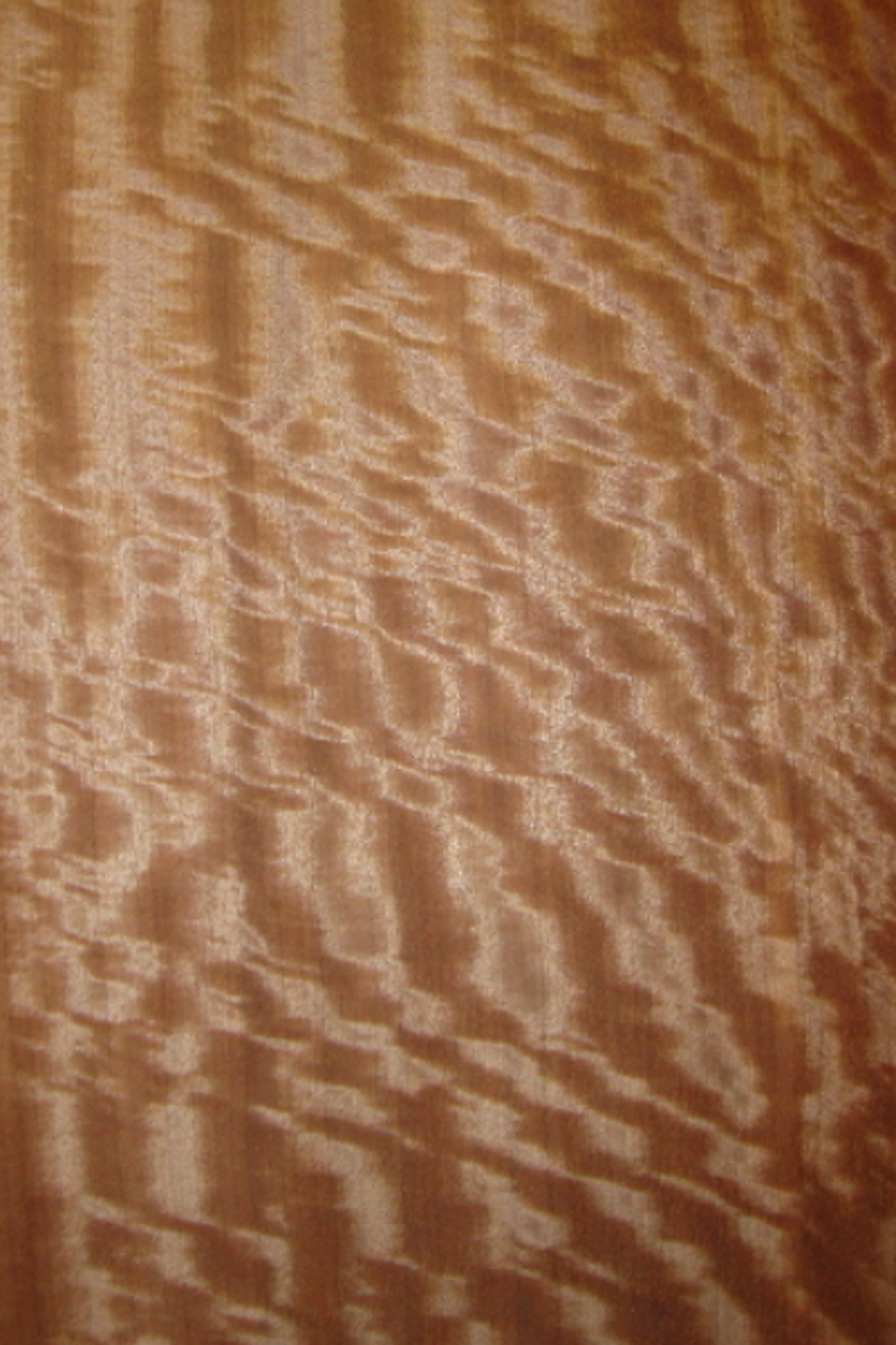
Where Telluride demanded that veneer prove itself against alpine cold and thin mountain light, Tempe reverses the equation entirely—here, Black Mottled Makore must hold its visual authority under relentless desert sun pouring through expansive glazing systems, and the species responds with remarkable resilience, its warm golden-tan base and dense amber-brown mottled figure actually gaining depth and dimensionality under high-UV exposure rather than washing out the way lesser veneers tend to flatten. The tightly stacked horizontal ripples interlaced with vertical ribbon striping create an optical movement that shifts throughout the day as Tempe's harsh, angled light migrates across interior surfaces, giving architects working in this market a material that performs as a living element within the stark geometric vocabularies of contemporary Sonoran design. Rosebud's three decades of species expertise matter acutely in this climate, because specifying the right flitch of Black Mottled Makore for a Phoenix-metro installation means understanding how that shimmering three-dimensional figure will interact not just with the architecture but with the punishing environmental conditions that define building in the desert Southwest. And yet for all that Tempe demands in terms of durability and light-fastness, the conversation is about to shift again—eastward, toward salt air, coastal humidity, and the entirely different design expectations that govern the Hamptons.